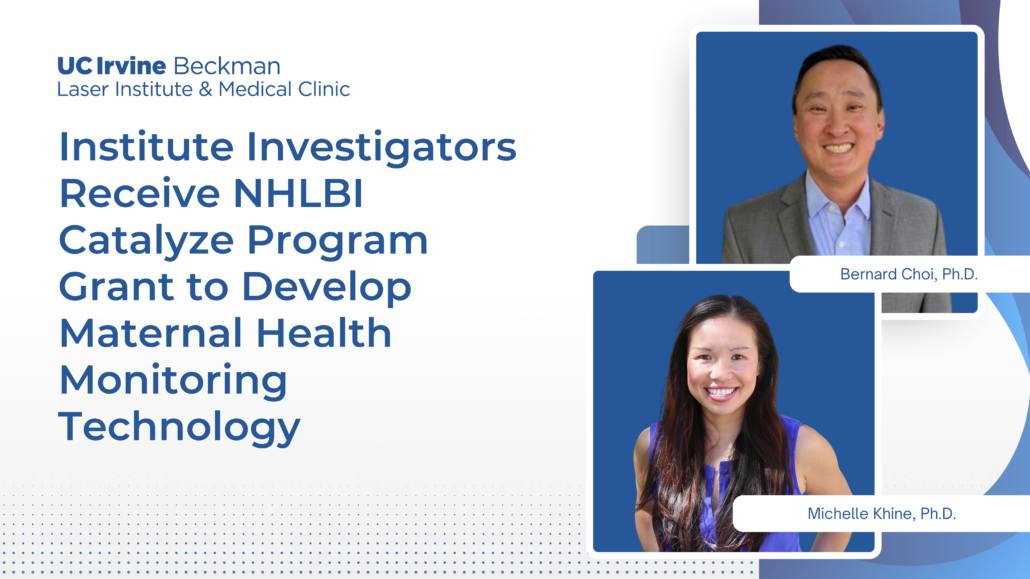
Institute Investigators Receive NHLBI Catalyze Program Grant to Develop Maternal Health Monitoring Technology
UC Irvine Beckman Laser Institute & Medical Clinic researchers Drs. Bernard Choi and Michelle Khine have been awarded a $1.2 million grant from the National Heart, Lung, and Blood Institute (NHLBI) for the project, “Maternal Obstetric Monitoring System (MOMS): a Postpartum Hemorrhage (PPH) Wearable Monitor.” This award brings the researchers into the NHLBI’s Catalyze Program, a comprehensive translational research support mechanism that provides funding, project management, technical services, and commercialization guidance designed to accelerate the translation of new therapies, devices, and diagnostics to market.
The project aims to develop MOMS, a technology designed to improve early detection of postpartum hemorrhage (PPH), a leading cause of maternal death. By continuously monitoring vital signs, measuring high-quality physiological waveforms, and performing advanced analysis of the measurements, MOMS seeks to identify significant blood loss in new mothers more effectively than current methods, potentially saving lives and improving maternal health outcomes.
The multidisciplinary team – comprising experts in biomedical engineering, obstetrics & gynecology, sociology, and data science – will create a miniaturized, wearable device integrated with multiple sensors. The device will simultaneously measure continuous blood pressure, heart rate, cardiac output, stroke volume, blood flow, hemoglobin oxygen saturation, and oxygen utilization to facilitate early detection of hypovolemia, or insufficient blood circulation.
The project will deliver a uniquely comprehensive hemodynamic and hemorrhage monitor specifically designed for PPH detection. The team will first finalize their alpha prototype and conduct preliminary validation. The next phase involves refining the technology to create a low-profile, user-friendly beta prototype based on end-user requirements and validated through testing on a diverse population. Data collected will inform predictive algorithm development, culminating in a pilot study with pregnant women during and after delivery.
Upon successful completion, the validated MOMS sensor technology will be ready for both hospital and ambulatory monitoring use during delivery and postpartum care. MOMS will provide more accurate, precise and robust early indicators of PPH than commercially available technologies, ultimately improving maternal survival rates.
NHLBI’s Catalyze Program enables and expedites the translation of basic science discoveries into new treatments, devices, and diagnostics for patients with heart, lung, blood, and sleep disorders (HLBS). The program advances potential new medical products through development to the preclinical testing stage by providing research funding, mentoring, advisory services, technology development guidance, regulatory affairs support, commercialization assistance, skills development and education.
About Catalyze
Catalyze’s mission is to provide comprehensive support and services to facilitate the transition of basic science discoveries into viable diagnostic and therapeutic candidates cleared for human testing, while developing a translational research workforce fluent in product development and entrepreneurship. The organization’s strategies include, funding for HLBS-related therapies, and diagnostics across the translational continuum; supporting scientists in setting achievable milestones that advance projects along the research pathway, educating investigators in translation, marketing, and product commercialization; anticipating researcher needs so they can focus on science rather than project administration; and pivoting funding and support quickly based on evolving project and scientific requirements.
Click here to learn more about Catalyze.
The research described above is supported by the National Heart, Lung, and Blood Institute of the National Institutes of Health. The content is solely the responsibility of the authors and does not necessarily represent the official views of the National Institutes of Health.

Author: Gabrielle Comfort